
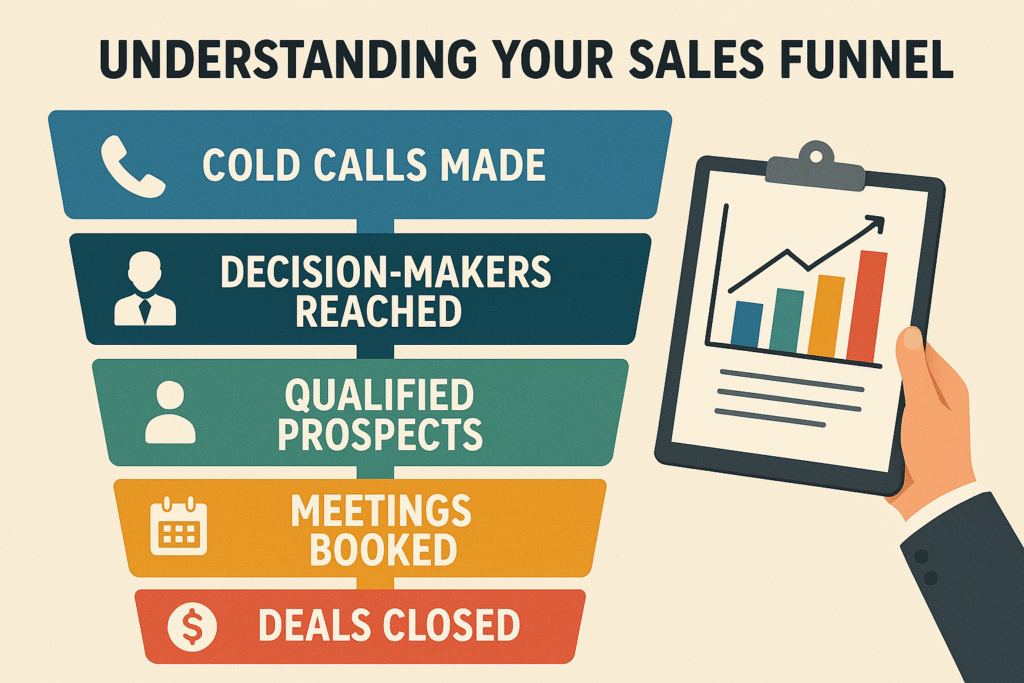
In the world of UK fuel card sales, success isn’t just about enthusiasm — it’s about precision. To consistently hit your monthly targets, you need to understand your sales funnel like a seasoned navigator reads a map. That means knowing exactly where your prospects are, how many calls you need to make, and how each stage of the funnel contributes to your bottom line.
Let’s break it down.
The Anatomy of a Fuel Card Sales Funnel
A typical B2B fuel card sales funnel includes:
- Cold Calls Made
- Decision-Makers Reached
- Qualified Prospects
- Meetings/Follow Up Demo’s Booked
- Deals Closed
- Commission Earned
Each stage has its own conversion rate — and understanding these rates is the key to reverse-engineering your monthly goals.
UK Cold Calling Benchmarks (2025)
According to Cognism’s 2025 State of Cold Calling Report:
- Average cold calling success rate in the UK: 8%
- Average number of dials per day per rep: 50+
- Average number of quality conversations per day: 4.4
- Average cold call duration: 93 seconds
- Best time to call: 10–11am or 2–3pm, especially on Tuesdays
Let’s apply this to a real-world fuel card sales scenario.
Reverse-Engineering Your Monthly Target
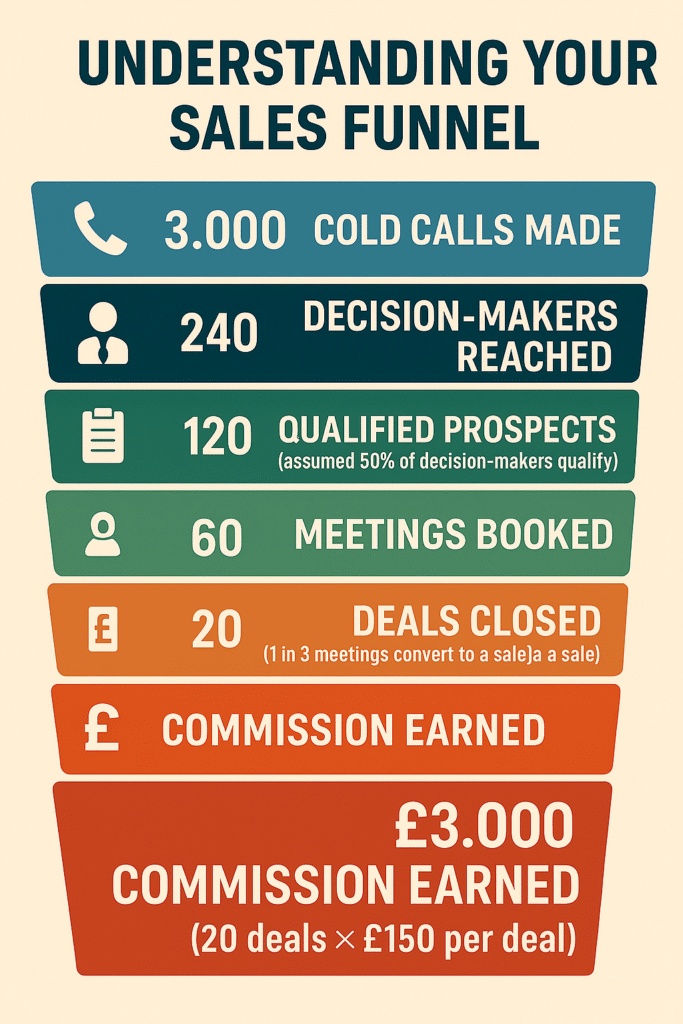
Let’s say your monthly commission goal is £3,000. If your average commission per sale is £150, you need to close 20 deals.
Now, let’s work backwards:
- Close rate from meetings: 1 in 3
- Meetings needed: 60
- Decision-makers needed: Assuming 1 in 4 calls reaches a decision-maker, you need 240 conversations
- Cold calls needed: With an 8% success rate, you’ll need to make around 3,000 calls in the month
That’s about 150 calls per day over 20 working days — a stretch, but achievable with focus, good data, and a strong pitch.
Dead Numbers & Data Hygiene
Don’t forget the “dead numbers” — disconnected lines, wrong contacts, or gatekeepers. These can make up 20–30% of your call list. Clean data is critical. Use verified B2B telemarketing databases and refresh your lists regularly to avoid wasting time.
Fuel Card Sales Specifics
Fuel card sales often involve:
- Fleet managers or procurement officers as decision-makers
- A longer consideration cycle than impulse B2B buys
- Price sensitivity and the need to demonstrate ROI (e.g. pence-per-litre savings, network coverage)
That means your pitch needs to be sharp, your follow-up tighter, and your funnel metrics even more dialled in.
Final Thoughts: Funnel Mastery = Predictable Income
When you understand your funnel, you stop guessing and start forecasting. You know how many calls you need to make, how many conversations to aim for, and how many deals to close. That’s how top performers in the UK fuel card industry stay consistent — even in a competitive market.
Want to go deeper? At Fuel Card Sales Academy, we teach reps how to track, tweak, and turbocharge every stage of their funnel. Because when you master the numbers, the results follow.